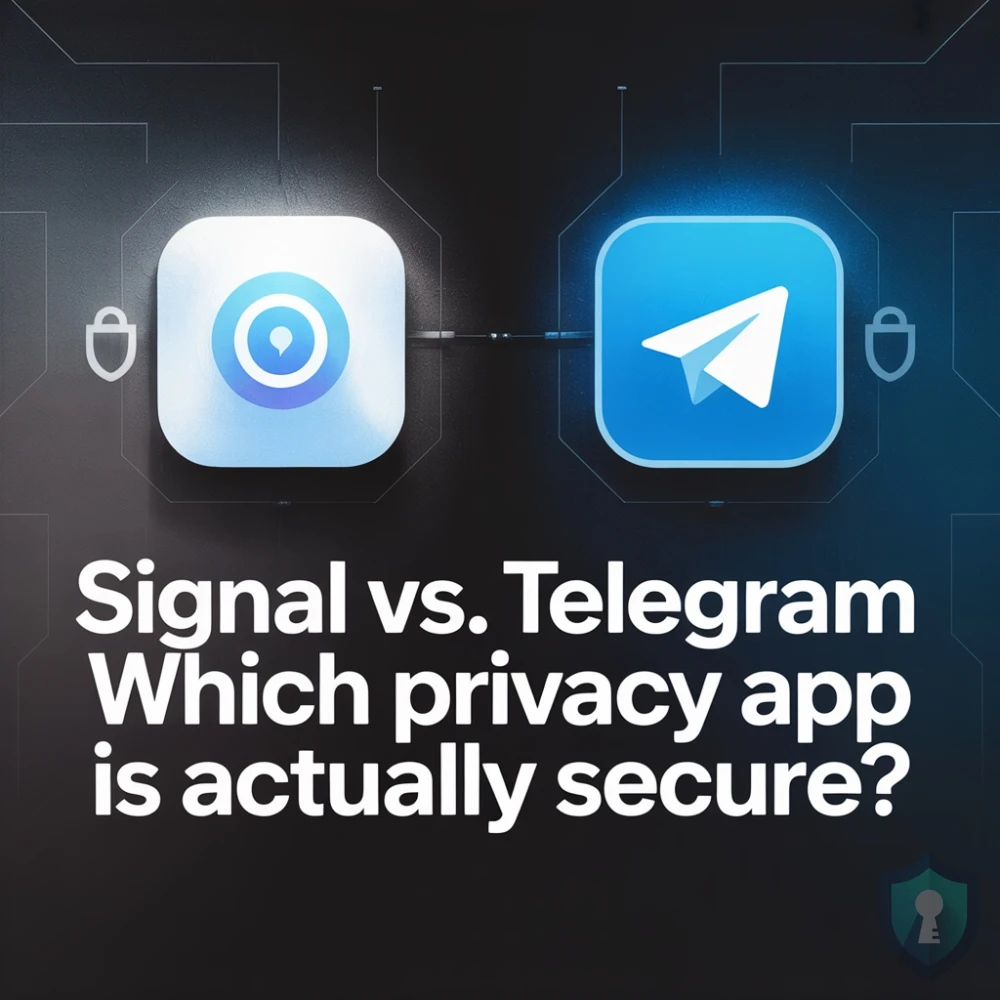
Whenever a massive data breach hits the news, millions of panicked users rush to the app store to download a “secure” messaging app. Almost instantly, the debate begins: should you download Signal or Telegram?
Because both apps market themselves as private alternatives to standard texting, most users assume they offer the exact same level of protection. In reality, they operate on two entirely different philosophies of digital privacy. One is an impenetrable digital fortress; the other is a massive public square.
If you want to keep your data out of the hands of hackers, data brokers, and government surveillance, here is the definitive breakdown of Signal versus Telegram.
1. The Encryption Difference (Default vs. Manual)
The most critical factor in secure messaging is End-to-End Encryption (E2EE). When E2EE is active, only the sender and the receiver have the keys to unlock the message. Even the app developers cannot read it.
Signal: The Gold Standard
Signal is built from the ground up for absolute security. Everything on Signal is end-to-end encrypted by default. Every text, voice memo, photo, and phone call is locked down the moment you hit send. The underlying cryptography (The Signal Protocol) is so universally respected that even WhatsApp and Skype adopted it to secure their own networks.
Telegram: The Cloud Compromise
This is where most users get confused. As we noted in our recent breakdown of exactly what Telegram is used for, the app is primarily a cloud-based messenger. By default, your messages are encrypted in transit, but the decryption keys are stored on Telegram’s servers. If Telegram’s servers are hacked, or if they are forced to comply with a government subpoena, your default chats can be read. To get true E2EE on Telegram, you have to manually open a specific “Secret Chat.”
2. Metadata (What Do They Know About You?)
In Open Source Intelligence (OSINT), investigators don’t always need to read your messages to track you. They just need your metadata-the data about your data (who you talked to, when you logged in, and your IP address).
If law enforcement serves a subpoena to Telegram, the company can potentially hand over your IP address, your contact list, and your device information.
If law enforcement serves a subpoena to Signal, they get almost nothing. Because of the way Signal’s servers are designed, the only two pieces of information they possess are the date you created your account and the date you last connected to their servers. They do not know who you are talking to, what groups you are in, or what your profile picture looks like.
3. Features vs. Privacy
If Signal is so much more secure, why does Telegram have nearly a billion users while Signal only has a fraction of that? It comes down to features.
Signal is barebones by design. Because it refuses to store your data on the cloud, transferring your account to a new phone can be a tedious process. Group chats are capped at a smaller number, and the app exists purely for 1-to-1 or small-group communication.
Telegram is a fully-fledged social network. It allows seamless multi-device syncing, file sharing up to 2GB, customized bots, and massive broadcast channels that can hold hundreds of thousands of users. It sacrifices absolute security for incredible usability.
Summary: The Security Showdown
| Feature | Signal | Telegram |
|---|---|---|
| End-to-End Encryption | Yes (Always on by default) | Yes (Only in manual “Secret Chats”) |
| Metadata Stored | Minimal (Account creation date only) | High (IP address, contacts, device data) |
| Open Source | 100% Fully Open Source | Only the client app is open source |
| Best Used For | Highly sensitive, private conversations. | Community building and following news. |
The Bottom Line
If your primary goal is finding large communities, following independent journalists, or sharing large files, Telegram is the superior app. However, if you are a whistleblower, an investigative journalist, or simply someone who believes your private conversations belong solely to you, Signal is the only logical choice.
Frequently Asked Questions (FAQs)
Which is safer, Signal or Telegram?
Signal is significantly safer for private conversations because it applies end-to-end encryption by default to all chats and calls. Telegram only applies end-to-end encryption if you manually initiate a “Secret Chat,” leaving standard messages vulnerable if Telegram’s cloud servers are ever compromised or subpoenaed.
Does Telegram hide your phone number?
By default, Telegram may share your phone number with people in your contact list or shared groups. To ensure privacy and prevent OSINT tracking, you must actively go into Telegram’s Privacy and Security settings and change your phone number visibility to “Nobody.” Signal also allows you to hide your number.
Can police track Signal messages?
No, police cannot read intercepted Signal messages due to its unbreakable end-to-end encryption. While law enforcement can issue a subpoena to Signal, the company physically cannot provide chat logs or contact lists because their servers are designed to never collect or store that metadata in the first place.