
You are standing on the coast, watching a massive cargo ship disappear over the horizon. Or perhaps you are waiting for an international delivery and the tracking just says “In Transit.”
Where is it?
Just like airplanes, almost every large vessel-from container ships to billionaire superyachts-broadcasts its location using a system called AIS (Automatic Identification System).
This data is public. You just need the right map. Here are the best free tools to track any ship in the world in 2026.
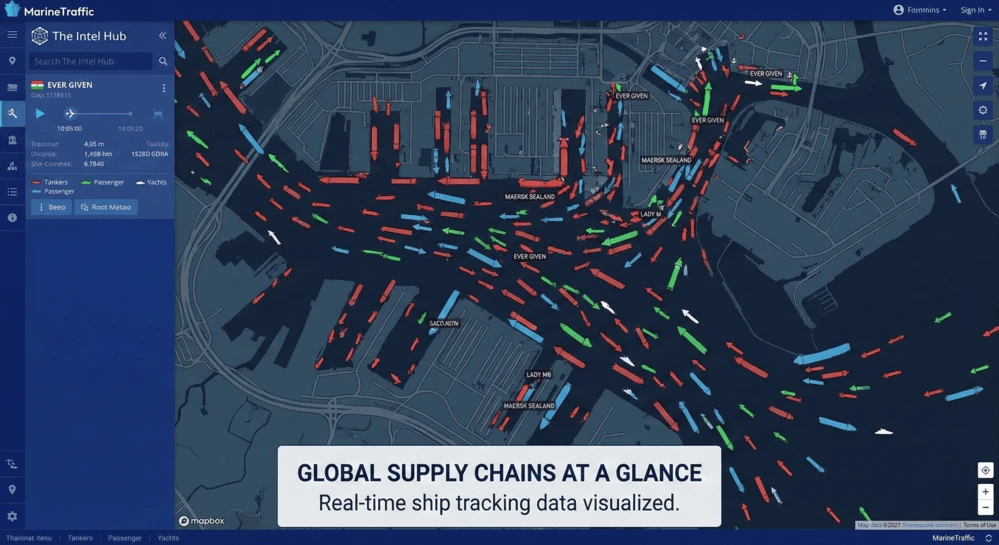
Method 1: MarineTraffic (The “Google Maps” of Ships)
MarineTraffic is the most popular ship tracking site in the world. It relies on thousands of coastal stations to pick up signals from ships near the shore.
How to use it:
- Go to MarineTraffic.com.
- Search for a ship name (e.g., Ever Given) or zoom in on a specific port.
What it reveals:
- The Route: See exactly where the ship is coming from and where it is going.
- The Cargo: It tells you if it’s a Tanker, Cargo Vessel, or Passenger Ship.
- The Photos: Users upload millions of photos, so you can see exactly what the ship looks like.
Note:
The free version only tracks ships near the coast. Once they go into the deep ocean, they switch to Satellite Tracking, which usually costs money.
Method 2: VesselFinder (The “Free Satellite” Alternative)
While MarineTraffic is prettier, VesselFinder is often more generous with its free data. Many investigators find that VesselFinder updates position data faster for smaller vessels or yachts.
How to use it:
- Go to VesselFinder.com.
- Use the map filters to select “Yachts” or “Cargo” depending on your target.
Pro Tip: If you can’t find a ship on MarineTraffic, always check VesselFinder. Sometimes one site picks up a signal that the other misses.
Method 3: Finding the Owner (IMO Lookup)
Seeing the ship is one thing; knowing who owns it is another.
Every registered ship has a permanent ID called an IMO Number (e.g., IMO 9811000). Even if the owner changes the ship’s name to hide it, the IMO number stays the same.
How to trace it:
- Find the IMO Number on the ship’s profile page (on MarineTraffic or VesselFinder).
- Go to Equasis.org (Free registration required).
- Enter the IMO number.
The Result: Equasis will give you the “Gross Tonnage” and, more importantly, the Registered Owner and Manager. This is how you find out that a random yacht actually belongs to a specific shell company.
Summary: The Marine Protocol
The Bottom Line
If it floats, you can probably track it.
Start with MarineTraffic to get the visual location. If you are investigating a specific target (like a luxury yacht), grab its IMO Number and run it through Equasis to see who pays the bills.
Broaden Your Scope: Now that you can track ships and Planes, you can monitor almost any heavy asset moving around the globe.