If you have followed our guides on using the Tor Browser, booting Tails OS from a USB, and verifying PGP signatures, you have built a formidable digital fortress. Technically speaking, you are invisible.
But in the world of cybersecurity and Open Source Intelligence (OSINT), a fundamental truth remains: Tools do not fail; humans do.
🛡️ Investigator Verified: NordVPN
Never conduct OSINT research or browse the Dark Web without encrypting your traffic. Your ISP logs your activity by default. We use and recommend NordVPN for its 100% RAM-only servers and strict zero-log jurisdiction.
30-Day Money-Back Guarantee
When law enforcement agencies or threat intelligence researchers de-anonymize a user on the Dark Web, they rarely do it by “cracking” Tor’s encryption. They do it by exploiting human error. OPSEC (Operational Security) is a mindset, not a software program.
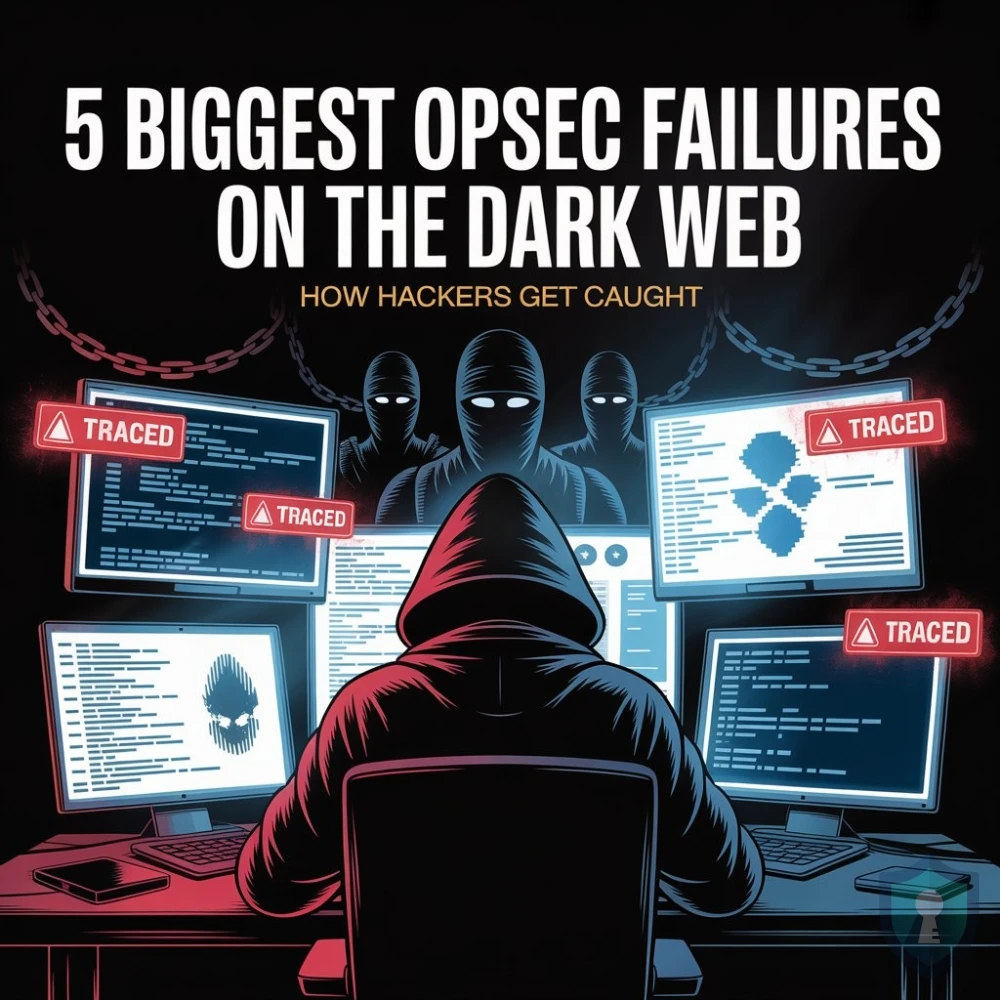
Here are the five most catastrophic OPSEC failures that researchers use to track and identify users on the deep web.
1. Identity Cross-Pollination (The “Surface Web” Bleed)
The absolute fastest way to get caught on the Dark Web is by letting your dark web persona touch your real-life, “surface web” identity.
Many amateur users will create a unique, anonymous username for a dark web forum, but then use that exact same username on a surface web platform like Reddit, Discord, or an old gaming forum. OSINT investigators routinely scrape dark web forums for usernames and run them through automated reverse-search tools. If your anonymous dark web handle is tied to an old Yahoo email address you used in 2012, your identity is instantly compromised.
The Fix: A true dark web persona must be entirely compartmentalized. Different usernames, different passwords, and entirely separate encrypted email providers (like ProtonMail) that are never accessed outside of the Tor network.
2. The Bitcoin Anonymity Myth
A terrifying number of people still believe that Bitcoin is untraceable. In reality, Bitcoin is one of the most transparent financial systems in the world.
Every single Bitcoin transaction is recorded on a public ledger called the blockchain. If a user purchases illicit data on a dark web marketplace and pays with Bitcoin they bought from a regulated exchange (like Coinbase or Binance), investigators simply follow the money. They trace the blockchain ledger backward from the marketplace wallet directly to the user’s Coinbase account, which is tied to their real name, social security number, and bank account.
The Fix: Serious privacy advocates never use Bitcoin for anonymous transactions. They use Monero (XMR), a privacy-coin specifically designed to obfuscate the sender, receiver, and transaction amount.
3. The JavaScript Window Trap
As we covered in our guide to Dark Web Search Engines, JavaScript is a massive security vulnerability.
When you install the Tor Browser, it warns you not to maximize the browser window to fill your entire screen. Why? Because websites use JavaScript to measure your screen’s exact resolution (e.g., 1920×1080). This data point is combined with your system fonts and time zones to create a unique “browser fingerprint.” Furthermore, malicious JavaScript can be deployed by law enforcement to bypass Tor and ping your actual router, revealing your real IP address.
The Fix: Always set the Tor Browser security level to “Safest” (which disables JavaScript globally) and never maximize the browser window. Keep the window at its default size so you blend in with millions of other Tor users.
⚡ Exclusive OPSEC Discount
Military-grade encryption shouldn't break the bank. Avoid data-harvesting "free" apps and secure your digital footprint with a premium, audited no-log VPN. Lock in the lowest possible rate using our exclusive investigator link.
Special offer applies automatically.
4. Linguistic OPSEC and Metadata Leaks
You can hide your IP address, but it is incredibly difficult to hide your personality. Threat intelligence analysts use a technique called “stylometry” to analyze how a user types.
Do you use British or American spelling (e.g., colour vs. color)? Do you frequently use specific slang or double-space after a period? This data is compiled to build a psychological profile.
Even worse are casual metadata leaks. A user on a dark web forum might complain, “It’s freezing and raining today,” or say, “I’ll upload the files after I get off work at 5 PM.” Investigators cross-reference these weather complaints and time-zones with global data to pinpoint the user’s exact city.
The Fix: In high-stakes environments, researchers run their forum posts through translation software (e.g., translating English to Russian, and then back to English) to scrub their unique linguistic fingerprints before posting.
5. Trusting the “Free” VPN
We cannot overstate this: using a free mobile VPN to access the Dark Web is worse than using no VPN at all.
When users connect to the Tor network using a shady, free VPN app, they assume their internet service provider cannot see them. However, that free VPN company is actively logging their real IP address, connection timestamps, and data packets. When a government agency serves that VPN company with a subpoena, the company will immediately hand over the server logs, completely de-anonymizing the user.
The Fix: If you are layering a VPN with Tor, it must be an independently audited, strict no-log premium VPN operating outside of the “14 Eyes” intelligence jurisdictions.
Summary: The OPSEC Golden Rules
| Failure Vector | How Investigators Track You | The OPSEC Defense |
|---|---|---|
| Usernames | Reverse-searching aliases on the surface web. | Absolute compartmentalization. Never reuse handles. |
| Cryptocurrency | Tracing public Bitcoin ledgers to KYC exchanges. | Utilizing privacy coins like Monero (XMR). |
| Browser Fingerprinting | Using JavaScript to read screen size and system data. | Setting Tor to “Safest” and never maximizing the window. |
| Linguistics | Analyzing spelling habits and weather/time complaints. | Scrubbing text and never discussing real-world details. |
The Bottom Line
The Tor network and Tails OS are incredibly powerful privacy tools, but they cannot protect you from yourself. True OPSEC requires absolute discipline. The moment you become lazy-reusing a password, mentioning your local time zone, or trusting an unverified link-your digital armor shatters. In the world of OSINT, your tools only get you through the front door; your discipline keeps you alive inside.
Frequently Asked Questions (FAQs)
What is OSINT and how is it used on the Dark Web?
Open Source Intelligence (OSINT) is the collection and analysis of publicly available data. On the Dark Web, researchers and law enforcement use OSINT techniques-like scraping forum posts, analyzing Bitcoin blockchains, and reverse-searching usernames-to track cybercriminals, uncover data breaches, and identify threat actors without breaking any encryption.
Can law enforcement track the Tor Browser?
While the Tor network’s encryption is exceptionally difficult to crack, law enforcement rarely needs to. Instead, they track Tor users by compromising the endpoints. They seize dark web servers, deploy malware to exploit outdated browsers, or rely on the user making a critical OPSEC mistake (like logging into a personal email account while connected to Tor).
Is it illegal to browse the Dark Web?
In most democratic countries, simply downloading the Tor Browser and navigating the Dark Web is entirely legal. The Tor network is used globally by journalists, whistleblowers, and privacy advocates to bypass censorship. However, utilizing the network to buy, sell, or view illicit materials is a severe criminal offense.
🔒 Don't Leave Your Network Exposed
You now have the intelligence to protect yourself, but knowledge without action is a vulnerability. Before you navigate away to start your research, ensure your connection is mathematically encrypted and hidden from third-party tracking.
Setup takes less than 2 minutes.